
Residential Demolition in Temple TerraceWhole-House & Structure Removal
- Licensed C-11855 · CUC041521
- Family owned since 1978
- We own the transfer station
- Serving 4 Tampa Bay counties
Temple Terrace, FL
Residential Demolition in Temple Terrace
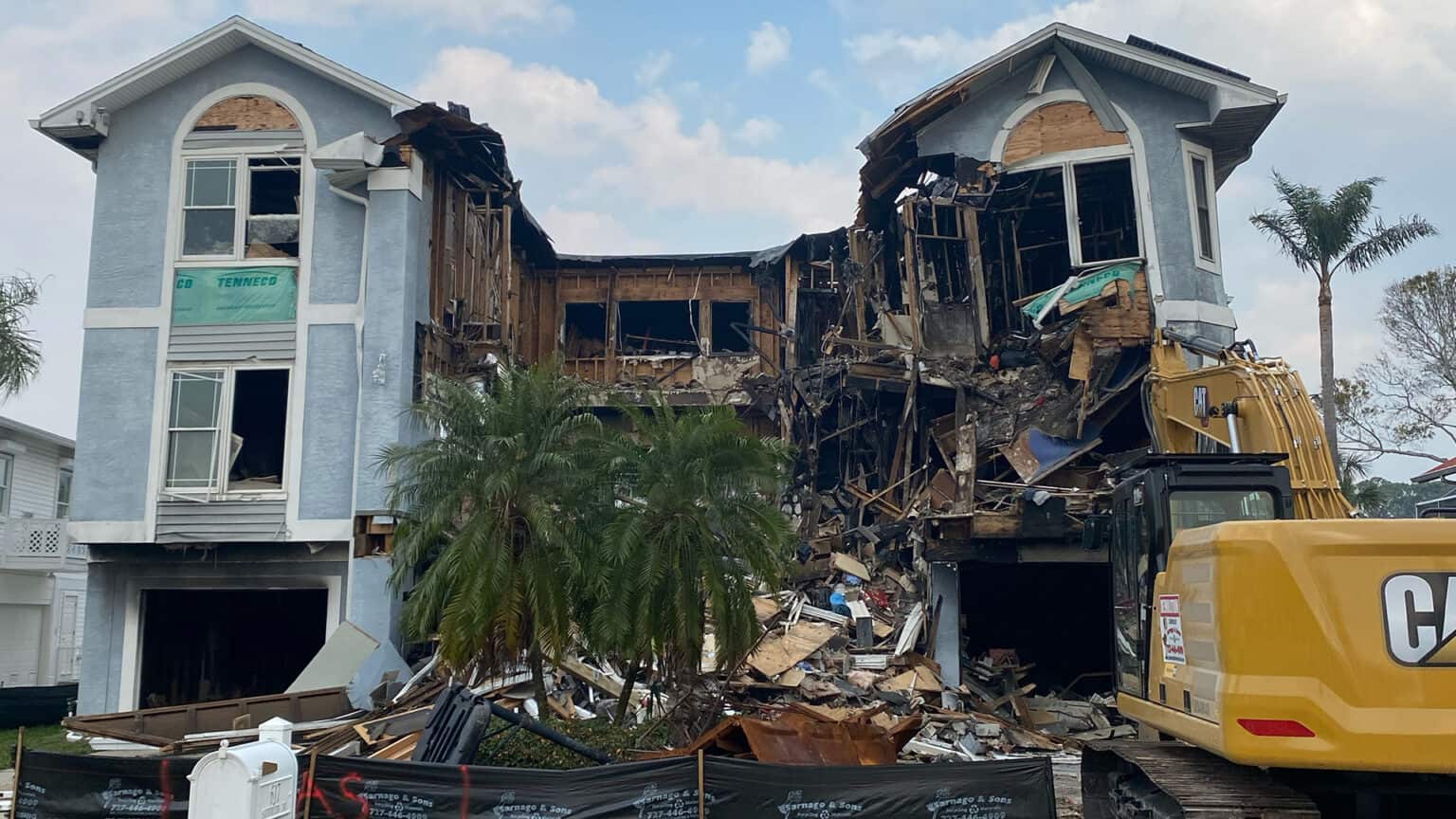
Taking down a house is mostly paperwork and disposal — the machine work is two or three days, and everything around it is what decides the price and the timeline. Our yard is about 45 minutes away, and we are licensed C-11855 and CUC041521.
Around the Temple Terrace Golf & Country Club the 1920s Mediterranean revival houses tend to be renovated rather than removed, and the city takes an interest in that heritage. The teardowns happen in the 1950s–70s block ranches that fill the rest of the city and in the fire- and neglect-damaged rentals near USF along 56th Street, where the asbestos survey often comes back positive.
Steady mid-scale work: block-ranch teardowns, fire- and neglect-damaged rental demolition near the university, and commercial removals along 56th Street. The 1920s golf-course district generates very little for us — those houses tend to be renovated rather than removed, and renovation demolition is not our trade.
A residential demolition in Florida runs on a fixed sequence: asbestos survey, utility disconnects, permit, then demolition. The survey comes first because the permit depends on it — every structure needs an asbestos survey before the municipality will issue a demolition permit, whatever its age, and most Tampa Bay housing stock qualifies. If asbestos is found, licensed abatement happens before we touch the building.
Utilities are the other gate. Power, water, sewer and gas have to be disconnected and confirmed by the utility itself, not just switched off at the house. Duke Energy, the water authority and the gas company each work to their own timeline, and we tell you exactly what to order and when so the permit is not sitting idle waiting on a meter pull.
What it costs
What drives a Temple Terrace quote
| Scope of job | What drives the number |
|---|---|
| Small house, under 1,200 sq ft | Access, foundation type, and how close neighboring structures sit |
| Typical house, 1,200 – 2,500 sq ft | Square footage, slab versus crawl space, disposal weight |
| Large or two-story house | Volume, structural complexity, and tight-access handwork |
| Asbestos abatement, if found | How much material and where it is — siding is cheaper than sprayed texture |
Every demolition is quoted on site, free. Access, structure and what has to be protected move the number more than square footage does, which is why we walk it rather than price it down the phone.
About 45 minutes — across the bay on the Courtney Campbell or Howard Frankland and up I-275, on the far side of Tampa. We batch Temple Terrace work into full-truck days so the crossing is paid for by full loads in both directions.
How it works
What a Temple Terrace job looks like
Asbestos survey
A licensed inspector surveys the structure. Pre-1981 buildings require this before the municipality will issue a demolition permit.
Disconnects and permit
Power, water, sewer and gas confirmed disconnected by each utility, then the demolition permit is filed with your city or county.
Demolish
The structure comes down in a controlled sequence, with loads sorted as they separate — concrete, metal, wood.
Foundation and slab
Footers and slab are broken out and hauled to our yard for crushing, unless you are keeping the pad.
Grade the lot
The site is filled where needed and graded flat, ready for construction or sale.
Questions
House Demolition in Temple Terrace — FAQs
How much does house demolition cost in Temple Terrace?
It comes down to the structure and the access, not the ZIP code. On small house, under 1,200 sq ft, what moves the number is access, foundation type, and how close neighboring structures sit. What moves it in Temple Terrace is whether the address is in the 1920s golf-course district, where the houses get renovated rather than removed and there is little for us. We walk the site and quote it, free.
Who disconnects the utilities?
The utilities do, and they must confirm it — a demolition permit will not close out on a house with a live meter. We tell you exactly what to order from Duke, the water authority and the gas company, and we sequence the job around their lead times.
Does the foundation come out too?
Usually yes — footers and slab are broken out, hauled to our yard and crushed into base material. If you are rebuilding on the same footprint we can leave a sound slab, though most new builds want it gone.
Can you prepare the lot for a new build?
Yes. Fill, compaction and crushed concrete base can run under the same contract, using material from our own yard, so the site is handed over as a buildable pad rather than a hole.