
Commercial DemolitionLicensed C-11855 Specialty Contractor
- Licensed C-11855 · CUC041521
- Family owned since 1978
- We own the transfer station
- Serving 4 Tampa Bay counties
Demolition
Commercial Demolition in Clearwater & Tampa Bay
Commercial demolition is a permitting and logistics job as much as a machinery job — the license is what lets us be on the site at all, and the sequence is what keeps everyone else on schedule.
We work as a licensed specialty demolition contractor (C-11855) with underground utility certification (CUC041521), which covers both the structure coming down and the service disconnection and site work that almost always comes with it. Commercial jobs rarely stop at the walls: there are grease traps, hydrants, laterals and abandoned services under most of these sites, and the underground license means we handle them under the same contract.
Every commercial demolition starts the same way regardless of size: an asbestos survey — required for commercial structures before a demolition permit is issued, with NESHAP notification where the findings demand it — then utility locates, disconnect confirmations, permitting, and an engineered take-down sequence with a protection plan for everything that stays.
Disposal is where a commercial number usually gets padded, and where ours does not. Demolition debris from a strip centre or a warehouse is mostly concrete, block and steel. The concrete and block come back to our own C&D transfer station and get crushed into base; the steel is recycled. We are not paying another company tipping fees and passing them on with a margin, because the disposal facility is ours.
On a teardown-to-rebuild we can carry the job through to a compacted, graded pad using our own recycled base material — demolition, clearance, fill and base under one contract instead of a handoff between three contractors. Family owned and operated since 1978.
Most demolition contractors pay a gate rate by the ton at a facility they do not own, add to it, and pass it on. Ours is the gate: the C&D transfer station on Keene Rd is ours, the concrete and block come back to be crushed, and the disposal line on the quote is what it actually costs.
What it costs
What drives a commercial quote
| Scope of job | What drives the number |
|---|---|
| Small commercial building, under 5,000 sq ft | Construction type, asbestos findings, and site constraints |
| Mid-size structure, 5,000 – 20,000 sq ft | Steel and concrete content, height, and disposal volume |
| Full site clearance to graded pad | Underground removals, fill quantity, and compaction requirements |
| Occupied or adjoining buildings | Protection, sequencing and what has to stay standing next door |
Every demolition is quoted on site, free. Access, structure and what has to be protected move the number more than square footage does, which is why we walk it rather than price it down the phone.
How it works
What the job looks like
Survey and notify
Asbestos survey completed and NESHAP notification filed where required — commercial demolition permits do not issue without it.
Locates and disconnects
Utility locates run, services cut and capped, and disconnections confirmed by each utility.
Permit and sequence
Demolition permit through the municipality, with an engineered take-down sequence and protection plan for adjacent property.
Demolish and sort
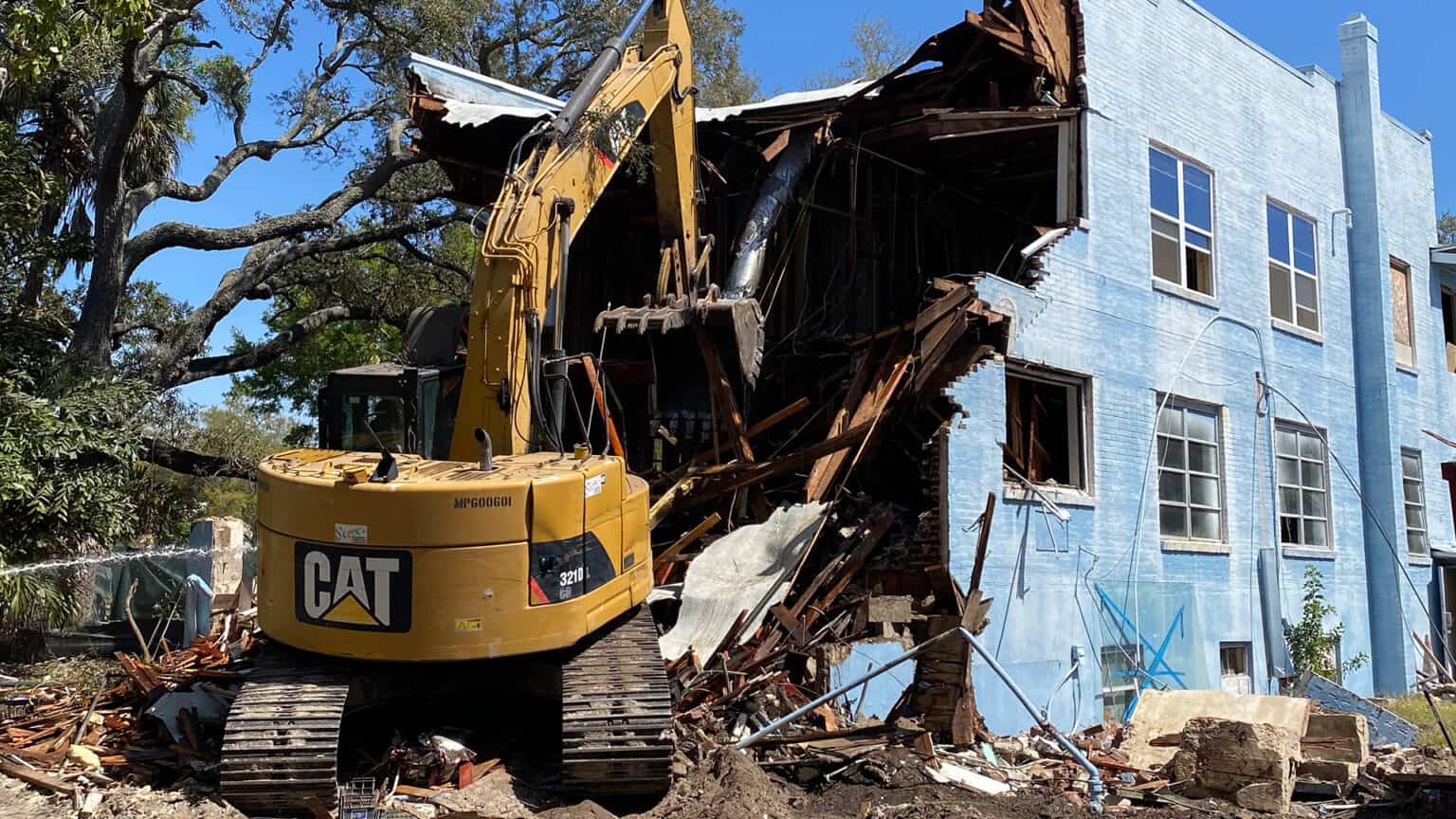
The building comes down, with concrete, block and steel separated as they come off.
Clear and grade
Site cleared, underground removals completed, and the pad filled and compacted with our own base material if you are rebuilding.
What a quote covers
Included
- Asbestos survey coordination and NESHAP notification where required
- Demolition permit and utility disconnect coordination
- Engineered demolition sequence and adjacent-property protection
- Underground utility removal under CUC041521
- Hauling and recycling through our own transfer station
What changes the number
- Occupied neighboring tenants mean dust control, vibration limits and scheduling constraints
- Underground storage tanks and grease traps trigger their own closure requirements
- Shared walls and zero-lot-line buildings need saw-cutting and shoring plans
- Bonding, insurance certificates and owner-required documentation on institutional work
- Right-of-way and lane-closure permits where the building meets the street
Questions
Commercial Demolition FAQs
Are you licensed for commercial demolition in Florida?
Yes — C-11855 as a specialty demolition contractor, plus CUC041521 for underground utility work. Those are the two licenses this scope actually requires, and we hold both directly.
What does commercial demolition cost per square foot?
Per-square-foot pricing depends on what the building is made of and what the survey finds. Light steel and block sit at the low end; heavy cast-in-place concrete costs more to bring down and process, and asbestos abatement adds meaningfully on older stock. Disposal terms matter too — our debris crosses our own scales, which shows up in the bid. We quote firm from drawings and a walk-through.
Is an asbestos survey required for commercial demolition?
Yes. Florida requires an asbestos survey before a commercial demolition permit is issued, and NESHAP notification to the state is filed before work begins. We coordinate both.
Do you handle the underground utilities?
Yes, under our own CUC041521 license — laterals, abandoned services, grease traps and site piping come out under the same contract rather than a second contractor.
Can you take the site through to a buildable pad?
Yes. Demolition, clearance, fill and compacted crushed-concrete base can all run under one contract, using material from our own yard.
Where does the debris go?
Concrete and block go to our own C&D transfer station on Keene Rd and are crushed into base material; steel is recycled. Owning the disposal facility is a structural cost advantage, not a slogan.