
Residential DemolitionWhole-House & Structure Removal
- Licensed C-11855 · CUC041521
- Family owned since 1978
- We own the transfer station
- Serving 4 Tampa Bay counties
Demolition
Residential Demolition in Clearwater & Tampa Bay
Taking down a house is mostly paperwork and disposal — the machine work is two or three days, and everything around it is what decides the price and the timeline.
A residential demolition in Florida runs on a fixed sequence: asbestos survey, utility disconnects, permit, then demolition. The survey comes first because the permit depends on it — every structure needs an asbestos survey before the municipality will issue a demolition permit, whatever its age, and most Tampa Bay housing stock qualifies. If asbestos is found, licensed abatement happens before we touch the building.
Utilities are the other gate. Power, water, sewer and gas have to be disconnected and confirmed by the utility itself, not just switched off at the house. Duke Energy, the water authority and the gas company each work to their own timeline, and we tell you exactly what to order and when so the permit is not sitting idle waiting on a meter pull.
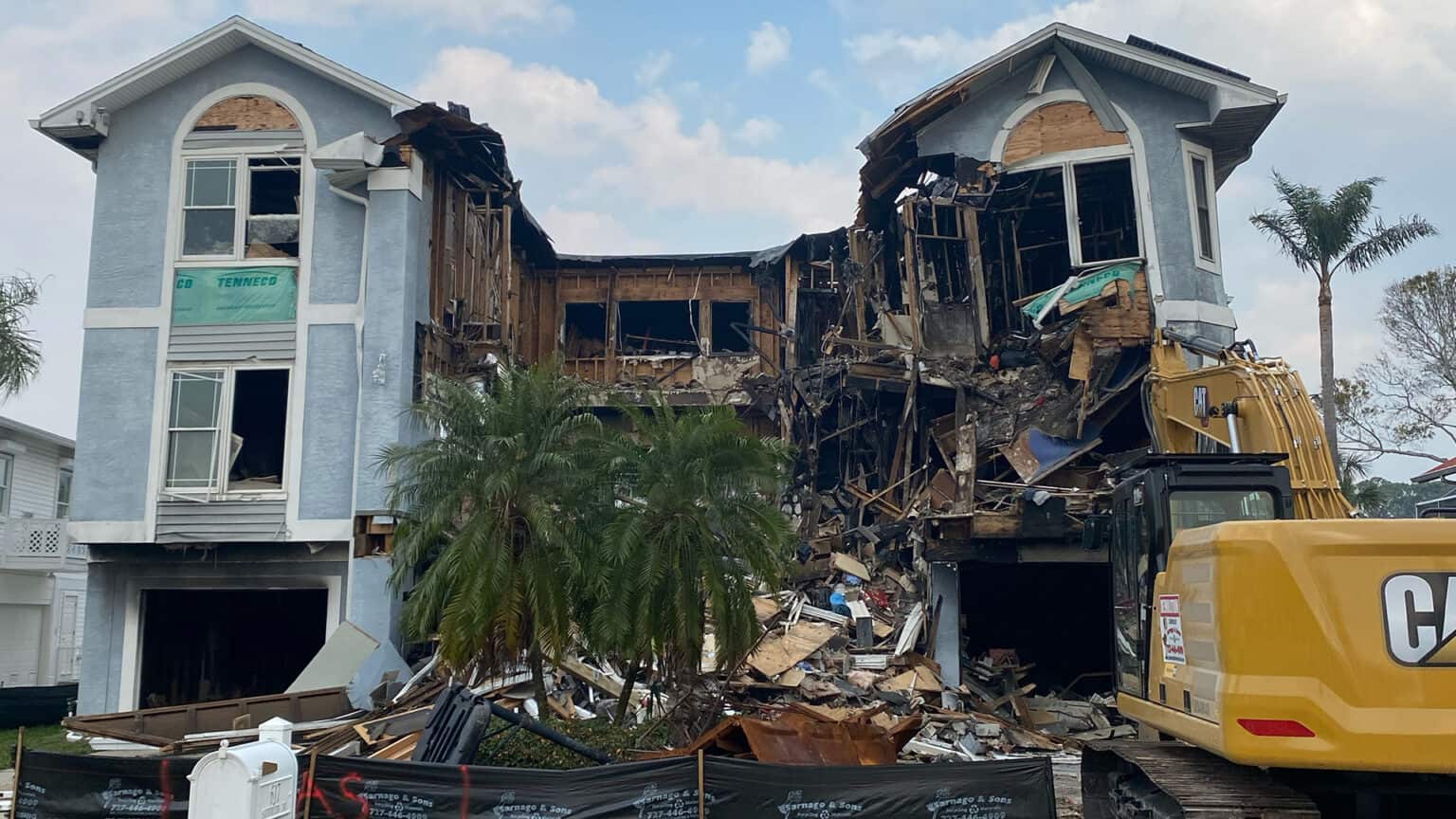
Once the permit posts, the demolition itself is quick. An excavator takes the structure down in a controlled sequence, loads are sorted as they come apart, and the foundation and slab usually come out with it. What makes our number different is where the debris goes: concrete and block return to our own C&D transfer station on Keene Rd and get crushed into base material. There is no subcontracted disposal line item with a markup on it, because there is no subcontractor.
We finish with a graded lot. If you are rebuilding, we can bring compacted fill and crushed concrete base back on the same contract — the same material that left as your old driveway, in some cases. Sarnago & Sons has been doing this work as a family business since 1978, licensed as a specialty demolition contractor (C-11855) with underground utility certification (CUC041521).
We run our own C&D transfer station at the Keene Rd yard, so demolition debris does not become a markup on someone else’s disposal invoice. Concrete, block and rock come back to us and get crushed into base material.
What it costs
What drives a house demolition quote
| Scope of job | What drives the number |
|---|---|
| Small house, under 1,200 sq ft | Access, foundation type, and how close neighboring structures sit |
| Typical house, 1,200 – 2,500 sq ft | Square footage, slab versus crawl space, disposal weight |
| Large or two-story house | Volume, structural complexity, and tight-access handwork |
| Asbestos abatement, if found | How much material and where it is — siding is cheaper than sprayed texture |
Every demolition is quoted on site, free. Access, structure and what has to be protected move the number more than square footage does, which is why we walk it rather than price it down the phone.
How it works
What the job looks like
Asbestos survey
A licensed inspector surveys the structure. Pre-1981 buildings require this before the municipality will issue a demolition permit.
Disconnects and permit
Power, water, sewer and gas confirmed disconnected by each utility, then the demolition permit is filed with your city or county.
Demolish
The structure comes down in a controlled sequence, with loads sorted as they separate — concrete, metal, wood.
Foundation and slab
Footers and slab are broken out and hauled to our yard for crushing, unless you are keeping the pad.
Grade the lot
The site is filled where needed and graded flat, ready for construction or sale.
What a quote covers
Included
- Demolition permit filed with your municipality
- Coordination of utility disconnect confirmations
- Complete structure, foundation and slab removal
- Hauling and recycling at our own C&D transfer station
- Rough grading of the cleared lot
What changes the number
- Pre-1981 construction triggers the asbestos survey requirement
- Septic tanks and wells need separate abandonment permits
- Trees inside the footprint, or protected trees near it
- Shared driveways, narrow lots and overhead lines slow the machine work
- Pools, sheds and fences on the same parcel are cheaper done in the same mobilization
Questions
Residential Demolition FAQs
How much does it cost to demolish a house in the Tampa Bay area?
Three things set the number: the size and construction of the house, how close a machine can get to it, and what the asbestos survey finds. A single-story block house on an open lot with a clean survey is the simple end; a two-story house on a tight lot with abatement work is the expensive end. Our quote covers permit, disposal and grading in one fixed figure, and the walk-through that produces it is free.
Do I need an asbestos survey before demolition in Florida?
Yes, whatever its age — Florida requires an asbestos survey before a demolition permit is issued, and most municipalities want the survey report with the application. We coordinate the survey as part of the job.
How long does the whole process take?
Plan on three to six weeks from signing to a cleared lot. The survey, utility disconnects and permit take most of that; the demolition itself is usually two to three days.
Who disconnects the utilities?
The utilities do, and they must confirm it — a demolition permit will not close out on a house with a live meter. We tell you exactly what to order from Duke, the water authority and the gas company, and we sequence the job around their lead times.
Does the foundation come out too?
Usually yes — footers and slab are broken out, hauled to our yard and crushed into base material. If you are rebuilding on the same footprint we can leave a sound slab, though most new builds want it gone.
Can you prepare the lot for a new build?
Yes. Fill, compaction and crushed concrete base can run under the same contract, using material from our own yard, so the site is handed over as a buildable pad rather than a hole.