
Commercial Demolition in SeminoleLicensed C-11855 Specialty Contractor
- Licensed C-11855 · CUC041521
- Family owned since 1978
- We own the transfer station
- Serving 4 Tampa Bay counties
Seminole, FL
Commercial Demolition in Seminole
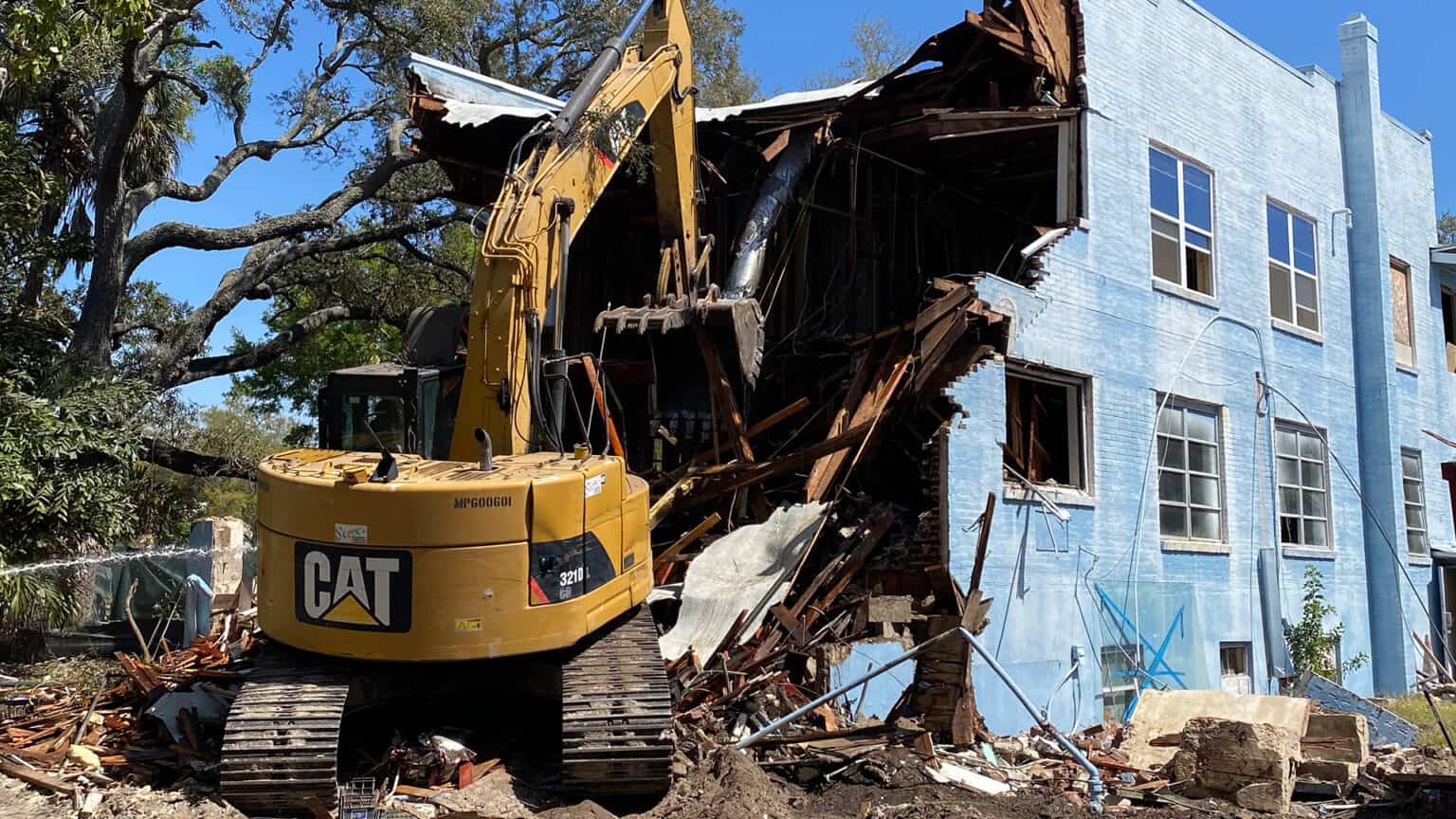
Commercial demolition is a permitting and logistics job as much as a machinery job — the license is what lets us be on the site at all, and the sequence is what keeps everyone else on schedule. Our yard is about 20 minutes away, and we are licensed C-11855 and CUC041521.
Mid-century commercial around the Seminole City Center area has already partly turned over, and what remains is small-footprint retail on generous lots—easy machine access, a modest slab, and a parking lot that often outweighs the building. We confirm whether the address permits through the City of Seminole or County Building Services before filing, since the line runs through addresses that all read as Seminole.
Seminole demolition is mostly clean single-house knockdowns — a fifty-year-old ranch coming down for a bigger new build — plus pool removals and mobile home haul-offs. Wide lots and easy machine access make these efficient jobs, and we price them that way.
We work as a licensed specialty demolition contractor (C-11855) with underground utility certification (CUC041521), which covers both the structure coming down and the service disconnection and site work that almost always comes with it. Commercial jobs rarely stop at the walls: there are grease traps, hydrants, laterals and abandoned services under most of these sites, and the underground license means we handle them under the same contract.
Every commercial demolition starts the same way regardless of size: an asbestos survey — required for commercial structures before a demolition permit is issued, with NESHAP notification where the findings demand it — then utility locates, disconnect confirmations, permitting, and an engineered take-down sequence with a protection plan for everything that stays.
What it costs
What drives a Seminole quote
| Scope of job | What drives the number |
|---|---|
| Small commercial building, under 5,000 sq ft | Construction type, asbestos findings, and site constraints |
| Mid-size structure, 5,000 – 20,000 sq ft | Steel and concrete content, height, and disposal volume |
| Full site clearance to graded pad | Underground removals, fill quantity, and compaction requirements |
| Occupied or adjoining buildings | Protection, sequencing and what has to stay standing next door |
Every demolition is quoted on site, free. Access, structure and what has to be protected move the number more than square footage does, which is why we walk it rather than price it down the phone.
Twenty minutes from the yard, all in-county surface roads, no bridge or toll. A Seminole teardown cycles loads back to Keene Rd fast enough that most single-house demos are cleared in a day or two.
How it works
What a Seminole job looks like
Survey and notify
Asbestos survey completed and NESHAP notification filed where required — commercial demolition permits do not issue without it.
Locates and disconnects
Utility locates run, services cut and capped, and disconnections confirmed by each utility.
Permit and sequence
Demolition permit through the municipality, with an engineered take-down sequence and protection plan for adjacent property.
Demolish and sort
The building comes down, with concrete, block and steel separated as they come off.
Clear and grade
Site cleared, underground removals completed, and the pad filled and compacted with our own base material if you are rebuilding.
Questions
Commercial in Seminole — FAQs
How much does commercial cost in Seminole?
It comes down to the structure and the access, not the ZIP code. On small commercial building, under 5,000 sq ft, what moves the number is construction type, asbestos findings, and site constraints. What moves it in Seminole is very little — wide lots and easy access make these efficient, and structure size ends up doing most of the work. We walk the site and quote it, free.
Do you handle the underground utilities?
Yes, under our own CUC041521 license — laterals, abandoned services, grease traps and site piping come out under the same contract rather than a second contractor.
Can you take the site through to a buildable pad?
Yes. Demolition, clearance, fill and compacted crushed-concrete base can all run under one contract, using material from our own yard.
Where does the debris go?
Concrete and block go to our own C&D transfer station on Keene Rd and are crushed into base material; steel is recycled. Owning the disposal facility is a structural cost advantage, not a slogan.