
House Demolition ProcessStart To Finish, Step By Step
Guide
House Demolition Process
The machine work is two or three days; everything around it is sequencing — and a job that starts the paperwork in parallel finishes a month sooner than one that does not.
The whole job at a glance
Here is the full sequence for a typical single-family demolition in Pinellas, Hillsborough or Pasco, with realiztic durations. Several of these steps run at the same time, which is why the total is closer to five or six weeks than the sum of the parts.
| Step | Duration | Runs in parallel with |
|---|---|---|
| Site walk and firm quote | 1–3 days | — |
| Asbestos survey and report | 3–7 days | Utility disconnect requests |
| Utility disconnects | 1–3 weeks | Survey, permit application |
| Permit application and issue | 1–3 weeks | Disconnects, NESHAP clock |
| NESHAP 10-working-day notice | 2 weeks | Everything above |
| Abatement, if the survey requires it | 2 days–2 weeks | Permit review, usually |
| Demolition | 1–3 days | — |
| Haul-off, slab and footings out | 1–2 days | Demolition, usually |
| Backfill, grade, final clean | 1–2 days | — |
Before anything moves: survey, permit, disconnects
Three tracks start on day one. The asbestos survey gets ordered first because its report feeds the permit application and, at least 10 working days before demolition, the NESHAP notification to the state. The utility disconnects — power, gas, water, sewer — get requested with each utility, because they run on the utilities’ schedules, not ours. And the permit application goes in to your city or county with the survey, site plan and disconnect confirmations attached.
Anything you want out of the house — fixtures, appliances, the good wood, sentimental hardware — comes out during this window. Once the permit is issued and the disconnects are verified, the house is a structure, not a building.
Demolition day, honestly described
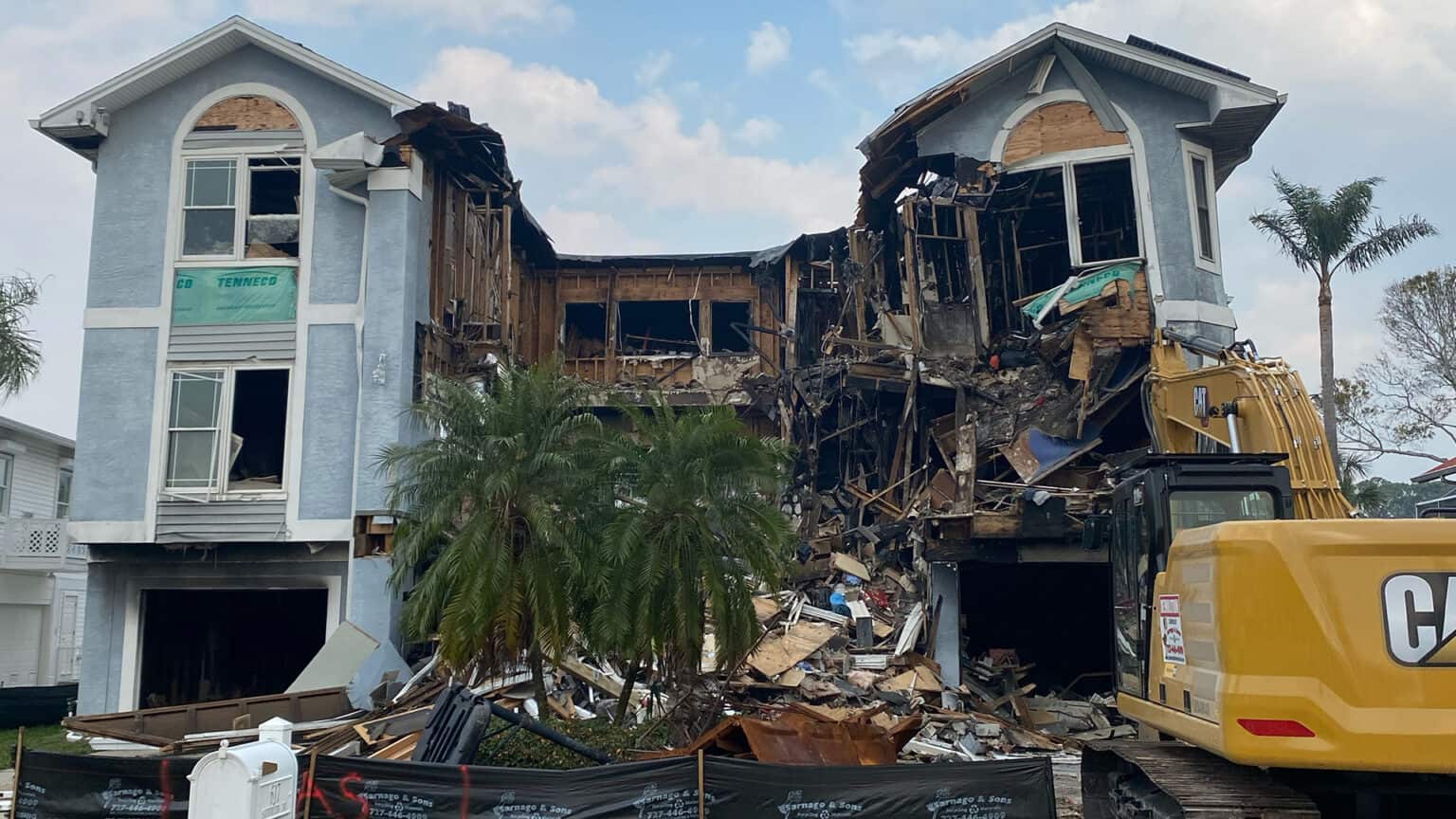
Most single-family houses come down mechanically with an excavator, and it is faster than people expect: a frame house is often on the ground before lunch, a block house takes a day or two. The skill is not in the knocking down — it is in working tight to property lines, keeping dust wetted down, protecting the trees and structures that stay, and loading out in sorted streams as the pile comes apart.
Concrete and block go in one direction, metals in another, mixed debris in a third. On our jobs the concrete stream goes straight back to our transfer station on Keene Rd to be crushed into base material — the sorting happens at the machine, not at someone else’s tipping floor.
What "done" means
The structure being gone is the halfway point. The slab, footings and driveway (if they are in scope — confirm this on any quote) get broken out and hauled. Septic tanks are pumped and crushed or removed per county rules; wells are capped or abandoned by a licensed well contractor. Then the hole gets filled and the lot graded.
Grading is where scope matters: a rough grade leaves the lot safe and tidy; compacted structural fill, placed in lifts and documented, leaves a pad you can build on. If a new house is going up, tell your demolition contractor — doing the fill right during demolition is far cheaper than re-excavating for the builder later.
The permit closes with a final inspection, and you are left with a clear, documented lot.
Questions
Common questions
How long does it take to demolish a house start to finish?
Typically five to six weeks from decision to graded lot in Tampa Bay — about a month of survey, disconnects and permitting, then under a week of actual site work.
What has to happen before demolition day?
The asbestos survey, the utility disconnects verified, the permit issued, and the NESHAP 10-working-day notice run out. All four can run in parallel.
Can I keep the driveway or slab?
Yes — scope is up to you. If you are rebuilding, an existing sound driveway is often worth keeping; the slab usually goes because the new foundation will not match it.
What happens to the septic tank and well?
The septic tank is pumped and then crushed in place or removed under county health department rules; a well is capped or abandoned by a licensed well contractor. Both should be in the demolition scope, not discovered after it.
Do I need to be there during demolition?
No. Most owners come by for the first hour — it is worth watching — but the site is ours to run once the permit is posted.