
Demolition vs RenovationWhen To Tear Down Instead Of Remodel
Guide
Demolition vs Renovation
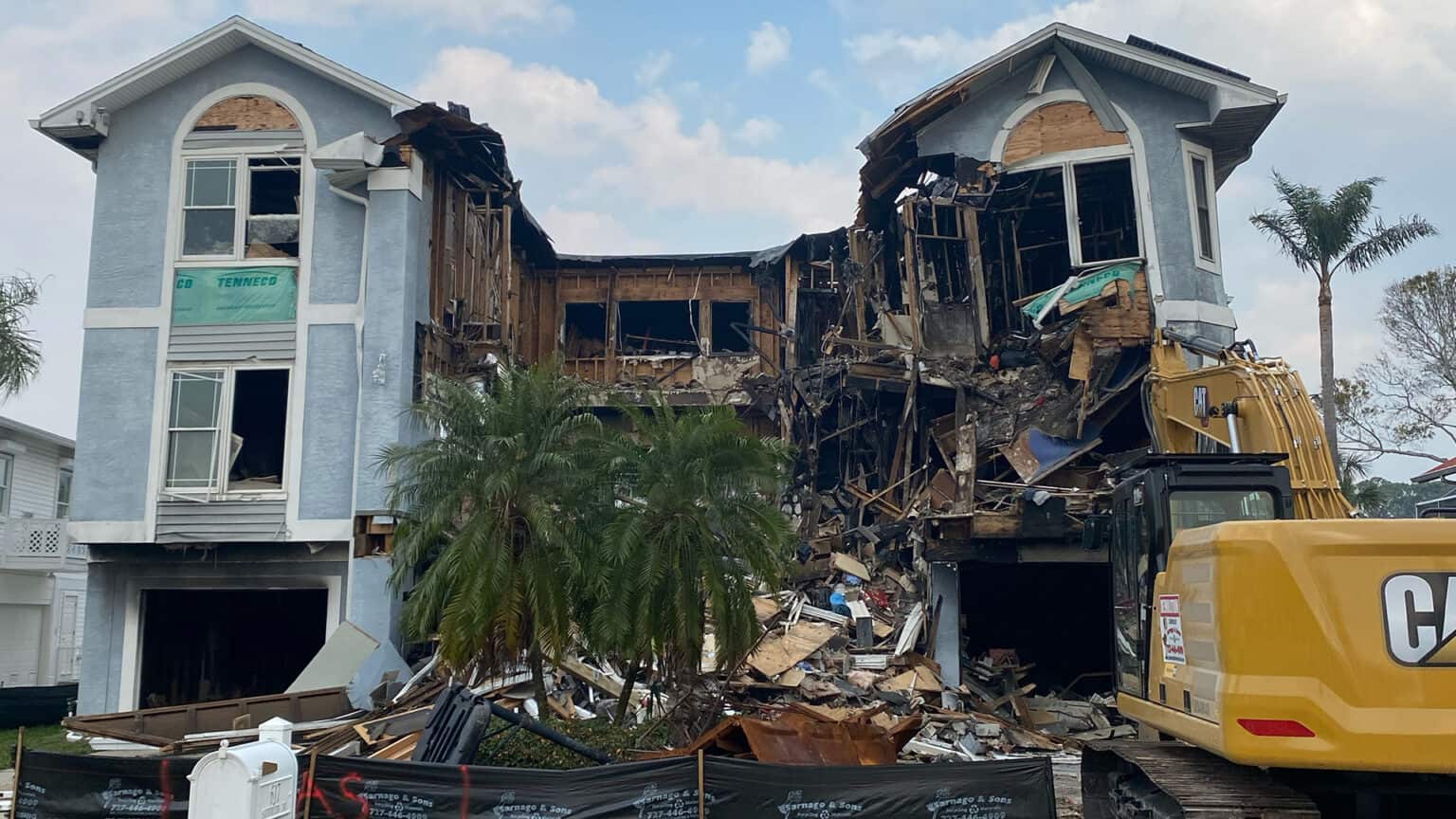
The honest version of this decision is arithmetic plus one Florida-specific rule — and in coastal Pinellas, the rule decides more often than the arithmetic.
The basic math
Renovation wins when the structure is worth keeping and the changes are cosmetic to moderate. Demolition wins when the cost of fixing what is wrong approaches the cost of starting over — because a renovation carries the old house’s constraints (layout, ceiling heights, slab elevation, aged systems) into the new budget, and a rebuild does not.
A rough but useful threshold: when honest renovation quotes reach 60–70% of the cost of demolishing and building new, the rebuild usually wins, because the renovated house still has the old bones, the old elevation and the old insurance profile, while the new one has none of them. Demolition itself is a small slice of the rebuild budget — usually well under 5% of the new construction cost for a block house here — so the decision is rarely about the demolition line item.
The 50% rule — the Florida factor
If the property is in a FEMA special flood hazard area — which covers a great deal of coastal Pinellas and the bay shorelines — the substantial improvement rule applies: when the cost of improvements or of repairing damage reaches 50% of the building’s market value (the structure’s value, not the land), the entire building must be brought into compliance with current flood regulations. For an older slab-on-grade house below today’s required flood elevation, that can mean elevating the house — often impractical — or rebuilding at compliant elevation.
This is why you see modest waterfront houses demolished rather than remodeled: the owner did not choose demolition over a renovation they could afford; the 50% rule made that renovation legally impossible without bringing the whole structure up to current code. Jurisdictions track improvement costs against the threshold, some across multiple permits over time, so this is not a rule you can approach in slices. Before planning a major remodel in a flood zone, get the building’s market value and the local floodplain office’s method in writing.
Signs the house is telling you to start over
Some conditions are repairable but rarely worth repairing. When two or three of these stack up, price the rebuild before committing to the remodel.
- Foundation settlement or a slab that has moved — fixable, expensive, and it never fully leaves the disclosure history
- The floor plan is wrong at the structural level: bearing walls where the space needs to open, ceilings at 7’6″
- Everything mechanical at once — repipe, rewire, new HVAC, new roof — on a house whose value cannot absorb it
- The house sits below required flood elevation in a mapped flood zone
- Widespread hidden damage: active termites in structural members, long-term leaks in the walls
- The lot is worth more than the house by a wide margin — common near the water
The middle path, and why it is not our job
Tear-down or cosmetic remodel is a false binary. A gut renovation — strip to block and frame, keep the shell, rebuild everything inside — keeps the grandfathered footprint on a nonconforming lot, which a tear-down forfeits. On a waterfront or undersized parcel that can be the deciding factor, and it is worth pricing before you commit.
We do not do that work. Sarnago & Sons takes whole structures down — houses, commercial buildings, mobile homes, pools — and we do not bid interior gut-outs or selective structural removal. That means we have no stake in talking you into a tear-down: if a gut renovation is the right answer for your lot, a remodeling contractor is who you want, and we will say so on the walk-through.
Questions
Common questions
Is it cheaper to renovate or rebuild?
Renovation is cheaper until it is not — once honest remodel quotes reach roughly 60–70% of tear-down-and-rebuild cost, the rebuild usually wins, because it sheds the old structure’s constraints instead of inheriting them.
What is the 50% rule in Florida?
In FEMA flood zones, improvements or repairs costing 50% or more of the building’s market value trigger full compliance with current flood regulations — often meaning the house must be elevated or rebuilt. It drives many coastal tear-downs.
Does the 50% rule apply to my house?
It applies if the structure is in a special flood hazard area, which covers much of coastal Pinellas and the bay shorelines. Your local floodplain administrator can confirm your zone and how your jurisdiction calculates the threshold.
How much does demolition add to a rebuild budget?
For a standard block house it is usually well under 5% of the new construction budget — the smallest of the three numbers in the tear-down-or-remodel math, which is why the decision seldom hinges on it.
Can I keep the shell and gut the inside instead?
Often, yes — a gut renovation keeps a grandfathered footprint on a nonconforming lot, which a tear-down would forfeit. It is the strongest argument against demolition where it applies.