
Site Clearance & Lot Clearing in New Port RicheyFrom Standing Structures to a Graded Pad
- Licensed C-11855 · CUC041521
- Family owned since 1978
- We own the transfer station
- Serving 4 Tampa Bay counties
New Port Richey, FL
Site Clearance & Lot Clearing in New Port Richey
Site clearance is everything between the lot you bought and the pad you can build on — and the fewer contractors that takes, the cheaper and faster it goes. Our yard is about 40 minutes away, and we are licensed C-11855 and CUC041521.
A condemned or fire-damaged house in Jasmine Lakes rarely comes alone: there is the shed behind it, the debris that piled up while it sat, and a slab the city wants gone too. The City of New Port Richey has cleared enough derelict structures that the paperwork moves quickly, and backhauling to Keene Rd instead of a Pasco gate keeps a small clear economical this far north.
New Port Richey runs on two engines: blight removal — condemned and fire-damaged structures the city wants gone — and flood-driven teardowns in Gulf Harbors, where substantially-damaged canal homes come down ahead of elevated rebuilds. Both are fast, high-volume demolition, which suits how we work.
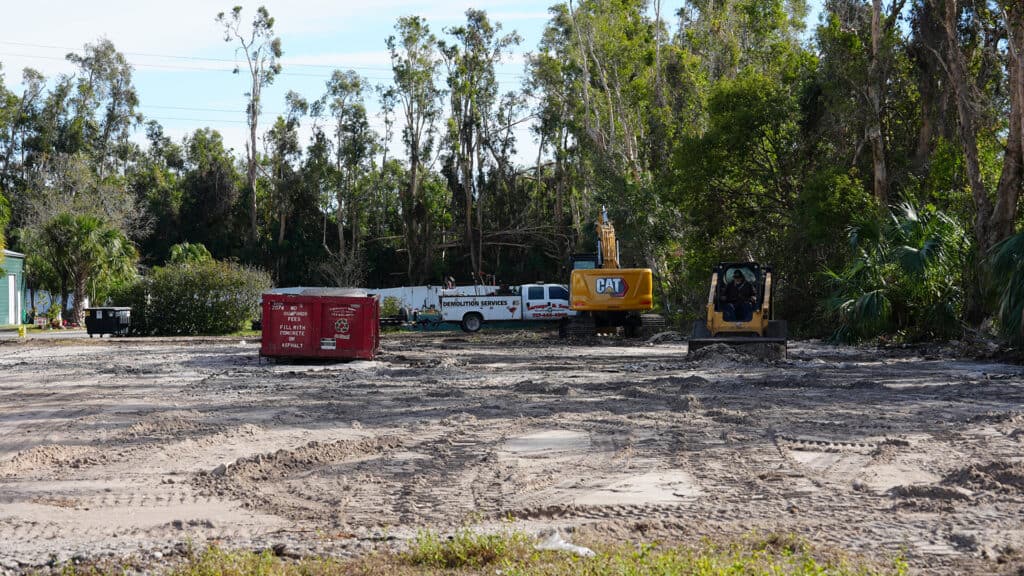
A clearance job can be one shed and some brush, or a house, a pool, three outbuildings and forty years of accumulated concrete. Either way the deliverable is the same: a clear, graded site with the underground surprises found and dealt with, handed over ready for the surveyor and the builder.
The sequence matters. Structures come down first — with the asbestos survey and permits their age requires — then slabs, footers and buried debris come out, then septic tanks and wells are abandoned to code, and only then does fill and grading make sense. Doing it out of order buries problems that cost more to dig up later.
What it costs
What drives a New Port Richey quote
| Scope of job | What drives the number |
|---|---|
| Light clearance — outbuildings and brush | Structure count, vegetation density, and haul volume |
| House plus site to cleared lot | The house demolition itself plus what else is on the parcel |
| Full clearance to compacted pad | Fill quantity, compaction spec, and underground findings |
| Septic abandonment or well capping | Tank size, access, and the county’s abandonment requirements |
Every demolition is quoted on site, free. Access, structure and what has to be protected move the number more than square footage does, which is why we walk it rather than price it down the phone.
About 40 minutes north on US 19 — no bridge and no toll, just corridor miles. We backhaul debris to our Keene Rd transfer station rather than paying Pasco disposal rates, which keeps our bids competitive this far north.
How it works
What a New Port Richey job looks like
Walk and scope
Every structure, slab, tank and tree on the parcel identified, with the permits and surveys each one needs.
Permits and disconnects
Demolition permits, tree permits where required, utility disconnects confirmed, and septic or well abandonment scheduled.
Structures down
Buildings, pools and outbuildings demolished and hauled in sorted loads to our yard.
Underground out
Slabs, footers, old services and buried debris removed under our underground utility license.
Fill and grade
Clean fill and crushed concrete base placed and compacted, leaving a pad ready for layout.
Questions
Lot Clearing in New Port Richey — FAQs
How much does lot clearing cost in New Port Richey?
It comes down to the structure and the access, not the ZIP code. On light clearance — outbuildings and brush, what moves the number is structure count, vegetation density, and haul volume. What moves it in New Port Richey is whether the structure is condemned or storm-damaged, because both change the survey and the sequence before anything comes down. We walk the site and quote it, free.
Do I need a permit to clear trees?
Often, yes. Most Tampa Bay municipalities protect certain species and sizes, and grand trees need specific approval. We check your city’s ordinance before quoting the vegetation scope.
What happens to the old septic tank?
It gets abandoned to county code — pumped, crushed or filled, and documented. Doing it during clearance is far cheaper than discovering it under a footer later.
What about things buried on the lot?
Old slabs, fill and debris turn up on long-held parcels. We probe where the history suggests it, and anything unexpected is priced at rates agreed up front rather than invented mid-job.