
Commercial Demolition GuideScoping, Sequencing & Bidding A Commercial Job
Guide
Commercial Demolition Guide
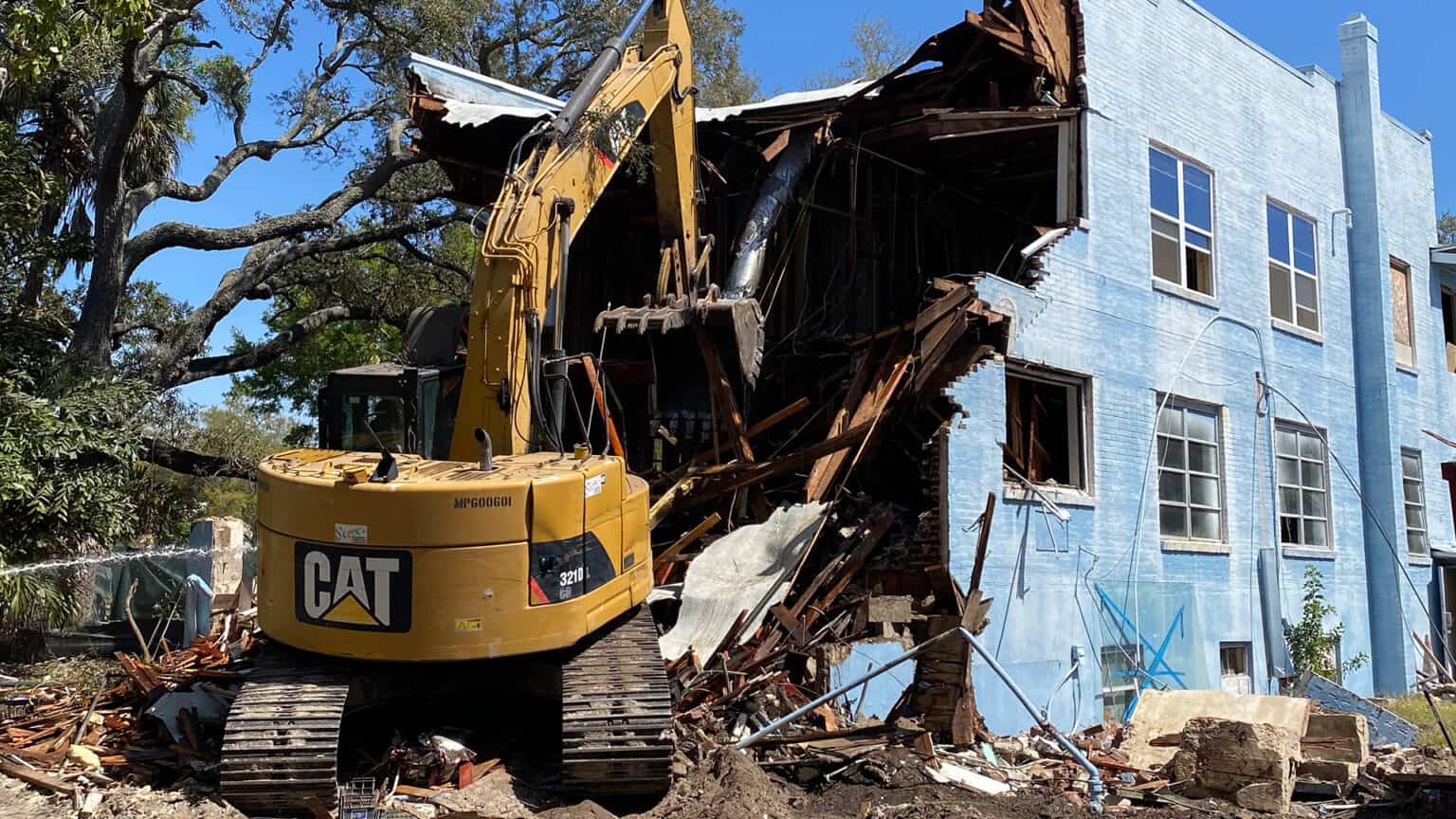
Commercial demolition is won or lost in the scoping — the machine work is the predictable part, and everything expensive hides in what the scope failed to say.
Scoping: the questions that define the job
Every commercial demolition bid is an answer to a scope, and vague scopes get padded bids — the contractor prices the uncertainty. The tighter these answers, the sharper the numbers.
- What has to survive? A party wall, a neighboring slab or a structure staying on the same parcel is priced by what must be protected, not by what comes down
- What do the surveys say? The asbestos survey is mandatory; on older commercial stock, budget for finding something. Lead paint and other regulated materials get assessed alongside
- Where are the utilities? Commercial services are bigger, older and worse-documented than residential — locates, as-builts where they exist, and pot-holing before anyone commits to a price
- What does the site allow? Working hours, noise limits, lane closures, crane or high-reach access, neighboring tenants in operation
- What condition is handover? Broom-clean slab, rough grade, or compacted pad certified for the next builder — three different jobs
Sequencing a commercial job
The sequence is broadly fixed, and the long-lead items front-load: surveys and abatement, utility kills on commercial services, permits and the NESHAP notification, engineering where the demolition sequence needs it (party walls, shared foundations, structures near occupied buildings). Then the visible phase — soft strip, structural demolition, slab and foundations, grading — which on most mid-size commercial buildings runs a few weeks.
A building next to an occupied one changes the rhythm rather than the method: protection goes up first, the sequence is agreed with whoever is still trading alongside it, and the noisy phases get scheduled around their hours. That coordination is worth more than a rate — a demolition that overruns by three days costs the project more than the saving on the bid.
Reading a demolition bid
Comparable bids answer the same questions explicitly. When one number is far below the others, the difference is nearly always in what is excluded — and exclusions surface later as change orders.
| Bid element | What to check |
|---|---|
| Licenses and insurance | Florida demolition licensure and limits sized to the project — ours are C-11855 and CUC041521 |
| Abatement | Almost always excluded pending survey; confirm how it will be priced if found |
| Disposal | Included in full, or per-ton with an estimate? Who owns the disposal site? |
| Foundations and slabs | To grade, or out of the ground? Deep foundations priced how? |
| Utilities | Cut-and-cap scope, and who holds the underground utility license for it |
| Site condition at handover | Written: what is filled, compacted, tested, documented |
| Diversion documentation | Scale tickets and diversion reporting where LEED or public-project mandates apply |
Where owning the disposal changes commercial bids
Commercial demolition tonnage is dominated by concrete and steel, and both streams have value on the other side of a scale. Ours cross our own scales: debris returns to our C&D transfer station on Keene Rd, the concrete is crushed into base material we sell, and the steel goes to scrap. On a concrete tilt-wall or block building, that is a structural cost advantage in the bid — not a rounding difference — and it comes with the per-load weight tickets that diversion reporting needs.
It also closes the loop on site work: demolition, clearance, and a compacted pad built from our own recycled base can run as one contract, one mobilization, one point of responsibility.
Questions
Common questions
How much does commercial demolition cost?
It prices per square foot, and four things set where a building lands: what the asbestos survey finds, how much foundation has to come out of the ground, what the site allows in access and working hours, and the disposal terms. A firm number comes from drawings and a walk-through, not from a market average.
What licenses does a commercial demolition contractor need in Florida?
Demolition is licensed contracting in Florida — we hold C-11855 as a specialty demolition contractor plus CUC041521 for underground utility work, and any bidder should show you theirs before you show them a site.
How long does commercial demolition take?
A few weeks of visible work for most mid-size buildings, behind four to eight weeks of surveys, abatement, utility kills and permitting. The front-loaded items set the schedule.
Can demolition and site prep be one contract?
With us, yes — demolition through to a graded, compacted pad using base material from our own yard, under one contract and one mobilization.
Do you provide LEED diversion documentation?
Yes — our debris crosses our own certified scales, so weight tickets and diversion summaries per load are routine, not a special request.